
Church Recording for Church of St. Michael, Garway, Herefordshire (in the diocese of Hereford)
| Post Code HR2 8RJ | Grid Ref. SO 455224 | Church Code 618210 |
The Church Recording Society Record of Church Furnishings by the Ross-on-Wye Group of Recorders started in 2022 during a period of Inter-regnum, completed 2024.

Garway is a small linear parish nestled at the foot of Garway Hill. From the A49 Ross to Hereford Road, turn west onto the B4521 towards Abergavenny. At Broad Oak there is a turning for Pontrilas where the road wends its way down into the Monnow Valley, bringing you to Garway Church.
6th c. Earliest mention of a chapel at Guorvoe is in the Book of Llandaff, the oldest document for the history of South Wales and the Marches. Garway lies in what was the small Welsh Kingdom of Ergyng, later anglicized to Archenfield. With a natural spring nearby of very pure water it was an ideal holy site.
1160. In the Doomsday record the place name Lagademer is annotated to ‘Garwi’ in the lands of Archenfield TRE (tempora regis Edwardis – in the time of Edward the Confessor) noting the current holder of the land as Herman (de Dreux).
1180-85. Henry II grants land to the Knights Templar who build separately a Church and Commandery. The church built with a round nave in the likeness of the Holy sepulchre in Jerusalem. Garway is one of only six remaining Templar churches in England but the only church with its original round nave foundations existing. The Commandery was built away from the church, part of its role was to house the sick and aged Templars. To help feed its members a substantial round Dovecote was built which can still be seen today.
1199. 6th July, King John confirms the gift of land.
1200s. The massive defensive Tower was built probably as a refuge against the hostile Welsh across the river Monnow.
1294. It is said the Grand Master of England Jacques de Molay visited Garway on the Feast of St. John the Baptist, 24th June.
1297. The Taxatio de Ecclesiastica Anglais et Walliae, assessed all churches for Tax. However, the Templars were not liable to pay taxes to the King or the Church, their allegiance was to the Pope. This caused a long running dispute with the Bishops of Hereford, with the Templars and later the Hospitallers refusing payment of dues.
1312. Philip de Mewes becomes Preceptor of Garway.
1312. Dissolution of the Order. Brother Philip de Mewes, Commander of Garway and Brother William de Pokelington were arrested, sent to the Tower of London.
1326. Knights Hospitallers are given the land, they alter the Nave to a square, but the remains of the original round Nave are still visible to the north side of the church.
1489. around this time Garway is merged with Dinmore Priory.
1535. Dissolved by Henry VIII, along with Dinmore Priory.
1536. With the Dissolution of Monmouth Priory by Henry VIII’s commissioners, the last Prior, Richard Taybush flees to the sanctuary of Garway, however the King’s men had arrived before him having seized all the Commandery’s rights and possessions.
1643. In a Parliamentary Survey the benefice is styled a ‘Rectory Impropriate’, with £40 yearly belonging to Thomas Pearle, gentleman.
1700s. A link corridor is built from the church to the tower. Seen as good building stone, Templar decorated coffin lids are moved to be utilized as lintels and benches.
1878. Some restoration takes place by E.H. Lingen Barker.
1895. Further restoration of the roofs to Nave and South Chapel by E.G. Davies.
1927. Excavations reveal Templar church round foundations.
1966. Listed as a 'Building of special Architectural or Historic Interest'.
1979. Listed as a Monument of National Importance.
1983. Cleaning and restorations to the foundation stones of the round Nave adjoining the North wall.
Today, the church and tower remain nestled in the valley, surrounded by green fields, the dovecot still visible across the field, a scene largely unchanged for over 800 years. But the Templars have not entirely left Garway, even today links to their occupancy are still being uncovered.
Garway is part of St. Weonards Group Ministry. Comprising St. Weonards, Orcop, Pencoyd, Tretire, Michaelchurch and Hoarwithy churches.
The Record has been sponsored by The Arts Society Ross-on-Wye.
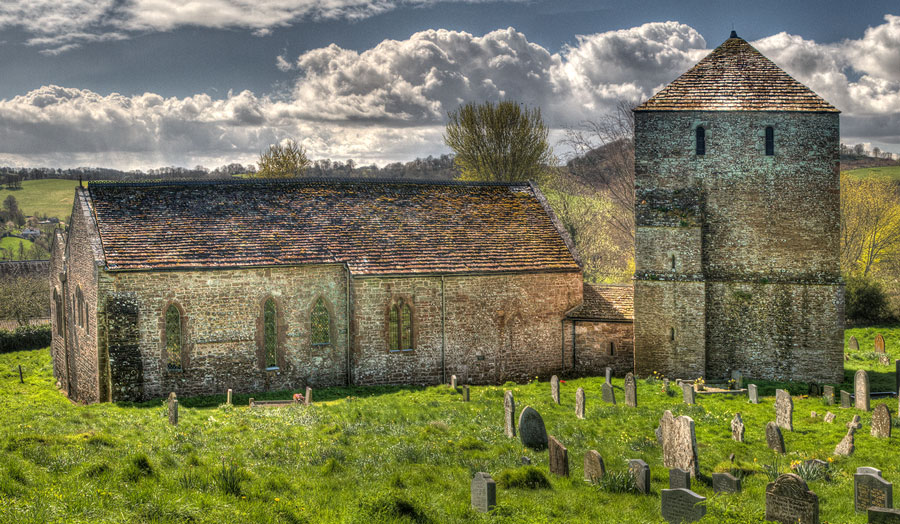
View of Garway Church

Church Plan